
Bhumi Pednekar: Celebrity and Environmental Activism Hand in Hand
- Arundhuti Panda

- Nov 27, 2025
- 5 min read
Updated: Feb 23
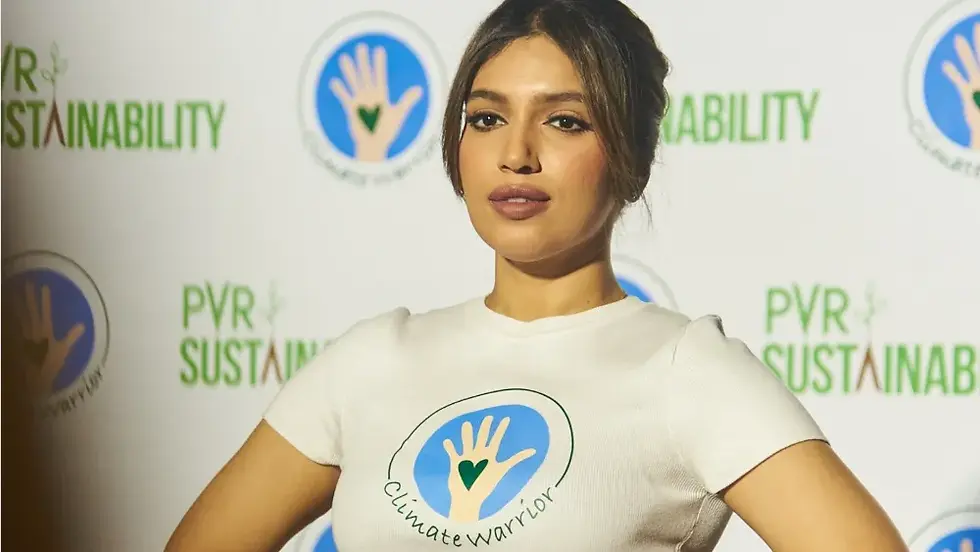
Bollywood actress Bhumi Pednekar has come up in Bollywood as one of India's most visible celebrity environmental activists, as she uses her film industry platform to advocate for climate action and sustainable living. However, her activism has also attracted scrutiny from critics regarding her activism’s authenticity, possible hypocrisy, and they also question the effectiveness of “celebrity-driven” environmental campaigns. Through this writing, I attempt to thoroughly examine and understand Pednekar's environmental work, her strategies for environmental activism, organisational initiatives, and the feminist and critical perspectives about her activism.
How Bhumi’s Personal Initiative Became A National Advocacy
As a child, Bhumi was greatly concerned and curious about environmental changes she witnessed, with learning about climate change, scarcity of resources- especially water, which is a resource that is synonymous with life. She saw nature getting destroyed and devastated as a child, and these fears led her to promote environmental awareness as a way to overcome, possibly the biggest threat to humanity today.
In 2019, she formalised her activism by launching Climate Warrior, a nationwide campaign for spreading awareness about environmental conservation and global warming through social media and on-ground practices and initiatives.
The Climate Warrior
Her campaign, Climate Warrior, is currently working as a non-profit advocacy platform that the celebrity funds through the remuneration she earns from acting. Campaign Warrior focuses on multiple causes for the environment: neutralising carbon footprints, shifting towards plastic-free lifestyles, supporting beach clean-up drives in Mumbai, promoting plastic-free film productions, and partnering with recycling and upcycling organisations. “Charity begins at home”- following this principle, Pednekar has often emphasised that her approach begins at home, as she is working to make her own home more sustainable before expanding to the outside, with bigger and broader goals.
International Recognition Of Bhumi Pednekar’s Environmental Activism
In March 2023, the United Nations Development Programme (UNDP)-India appointed Bhumi as the country's first National Advocate for Sustainable Development Goals (SDGs). This prestigious role positions her to support UNDP India's efforts to raise awareness for the environment and the SDGs, aligning with the Millennium Goals, which are, for example, ending poverty, protecting the planet, and ensuring peace and prosperity. In 2024, the World Economic Forum further recognised her contributions by naming her a Young Global Leader, which made her the first Indian actress to attend the Young Global Leaders Summit in Geneva.
How Pednekar Uses Her Platform And Her Reach For Her Advocacy
Pednekar's best advocacy tool is her huge social media following, which exceeds 10 million followers across platforms like Instagram and Twitter. Through Climate Warrior, she consistently posts educational content about environmental issues and shares practical tips for sustainable living. She also speaks about the work of grassroots environmental activists and citizen groups all over India on her social media platforms.
She uses her platform to create a sense of the urgency of climate action, frequently stating that "we are at a tipping point" and that "climate change is real and unfolding before us". She has been vocal about calling out the urban class as "the biggest abuser of natural resources," and she urged the middle-class Indians to adopt sustainable practices like reducing water waste, conserving electricity, avoiding single-use plastics, and preventing food wastage.
She also engages in on-ground initiatives and partnerships for environmental projects. She has planted thousands of trees on the outskirts of Mumbai, participated in beach clean-up drives, and collaborated with organisations like Healing Himalayas, an NGO dedicated to removing pollution from mountain regions after tourist seasons. In 2020, she joined the “Fridays For Future-Mumbai chapter” for a silent protest march demanding climate justice, leading hundreds of Mumbaikars in raising awareness about environmental degradation. Pednekar has also partnered with global projects such as “Count Us In”, working with former UN Climate Chief Christiana Figueres to educate Indians about reducing their carbon footprints. Her activism goes to advocacy for waste segregation, rainwater harvesting, recycling, and campaigns against open defecation, which are prominent issues that involve environmental sustainability in relation to public health and sanitation.
She also uses cinema as a powerful medium for social change. She has consistently chosen film roles that address social taboos and stigmas, including body positivity (Dum Laga Ke Haisha), open defecation (Toilet: Ek Prem Katha), and feminist rights (Badhaai Do). She wishes to work on a film specifically focused on climate change, using cinema to ignite national awareness on the environment and sustainability. Pednekar has advocated for plastic-free film productions and works to integrate sustainability practices within the entertainment industry.
Criticisms: Hypocrisy, Questions On Authenticity, And Is Celebrity Activism Just A Pr Gimmick?
Pednekar's activism is seeing criticism at present, as some critics are pointing out the hypocrisy related to her appearance. Social media trolls have repeatedly targeted her for alleged cosmetic procedures, particularly lip fillers and other facial enhancements. One social media platform user commented that "Environment and silicone/plastic are not environmentally friendly", pointing to the irony of an environmental activist promoting natural living while also using synthetic materials like silicone and undergoing cosmetic procedures, which are seen as unnatural and artificial practices that some view as the opposite of sustainable practices. Pednekar has addressed these criticisms with characteristic defiance. In a 2025 interview with News18 Showsha, she said: "We live in a time where people should make their own choices. I am nobody to have any kind of judgment on what people want to do. I also feel that this is being discussed way too much”.
Critics have also pointed out the inherent contradictions in celebrity activism. While Pednekar advocates for reduced consumption and carbon footprints, she is also living a lifestyle that has considerable environmental impact, which includes frequent travel, high-fashion consumption, and participation in an industry known for its extremely high use of resources for production. Pednekar herself has acknowledged these concerns, stating in an interview that she defended her use of influence, asking rhetorically: "If I am in a place of power, what is my biggest soft power? It is my influence. So, am I not to use that?”
There are also questions on The Bhumi Foundation's model of financing. It is solely functioning on Pednekar's personal income instead of relying on external donations, which can both be beneficial and limiting, but it also raises some red flags. This means that there is no corporate influence and that it is a show of personal dedication. It does, however, create doubts about scalability and long-term viability. Interestingly, it is not very clear what specific projects The Bhumi Foundation has supported, how much money went to various initiatives, or what impact analyses it conducts. While she has outlined the foundation's objectives publicly, such as financing climate initiatives, making documentaries, sponsoring awareness events, and investing in green start-ups, the actual funded projects and results are not transparently available to the public, leading to public mistrust of celebrity activism.
Conclusion
From a feminist perspective, it is both empowering and contradictory that Pednekar's career upholds patriarchal violations in terms of challenging patriarchal norms and focusing on women's agency in her film roles and upholds feminist values in defending bodily autonomy against trolling. Her very recent shift towards a more glamorous appearance in her presentation and the aggressive attention she receives, however, betray the long-held double standards that regulate women's public existence. Her activism has managed to make climate awareness more mainstream among Indian viewers, and this proves that celebrity power can be used for social causes. Whether it actually translates into effective policy change and behaviour change at scale is a question that remains open, one that will most likely decide the long-term judgment of her activism in environmental sustainability and preservation legacy.
[This article is brought to you by the Matika Circle of The Gal Gala for our November activity with the aim to promote a culture of critical and conscious fandom.]

Comments